You walk into a tire shop in Champaign IL and there they are: three tires from the same brand on the wall, and the only thing that obviously changes up the row is the sticker. Good, better, best. The salesperson says the top one is “a better tire.” You nod, with no idea what that means.
Nobody ever explains it. Buying tires in Champaign IL should not require decoding marketing language, so this post compares the tiers on every axis except price: mileage warranty, wet grip, the rubber and the casing, road noise, and realistic service life on Champaign County roads. Numbers belong at the counter, since the only accurate figure is a current quote on the sizes that fit your vehicle.
The wall is a price ladder, but the tiers are real engineering
People get this wrong in both directions. Cynics assume good/better/best is pure marketing, the same tire with three labels. Optimists assume the top tier wins at everything. Inside one maker’s lineup the tiers really do differ physically: how the tread rubber is compounded, how many reinforcing layers sit in the casing, how the tread blocks are shaped and spaced. Those choices produce the different mileage warranties and the different behavior in rain.
What the tier does not tell you is how it stacks up against another brand’s tier. A “best” from one company and a “better” from another can land in very different places, because tier position describes a maker’s own lineup, not an industry ranking. Keep that in mind when comparing tire brands Champaign shops actually stock.
Start with the three-part code molded into the sidewall
Every passenger tire has a short code stamped into the sidewall, something like 500 A A or 800 A B. That is the federally required Uniform Tire Quality Grading system, and it gives you three things:
- Treadwear, the number. A comparative wear rating.
- Traction, the first letter. Wet stopping ability, graded AA, A, B or C.
- Temperature, the second letter. Heat resistance, graded A, B or C.
It is the closest thing to a free spec sheet in the shop, and more limited than most people assume, with the limits written into the regulation itself.
Treadwear mileage: a comparative grade, not a promise
The treadwear number is not a mileage estimate. Federal regulation calls it “a comparative rating based on the wear rate of the tire when tested under controlled conditions on a specified government test course.” A tire graded 150 would wear one and one-half times better than a tire graded 100 on that course.
That course is a loop of roughly 400 miles near San Angelo, Texas, run for 16 circuits, about 6,400 miles, after a two-circuit break-in. The wear rate then gets projected out.
Which brings us to the sentence the regulation requires manufacturers to disclose, and which no tire ad has ever put in large type: “The relative performance of tires depends upon the actual conditions of their use, however, and may depart significantly from the norm due to variations in driving habits, service practices and differences in road characteristics and climate.”
Driving habits, service practices, road characteristics, climate: every one of those variables is yours, not the tire’s.
The mileage warranty is a separate thing from the treadwear grade, and here is how it actually behaves:
- It is set per tire line, not per brand. Michelin states plainly that mileage treadwear warranties vary by tire line and sends customers to the retailer or the warranty document for a line’s figure.
- According to Consumer Reports, manufacturer treadwear warranties typically run between 50,000 and 90,000 miles.
- If a tire wears out early, the claim is prorated, and the credit has to go toward the same replacement tire. Not a refund, not a free set.
- Workmanship and materials coverage is separate and usually time-limited. Michelin’s runs for the life of the original usable tread or six years from purchase, whichever comes first.
The practical warning: mileage warranties expect you to have maintained the tires, which means rotation records. Plenty of drivers hit the mileage, go to claim, and learn the paperwork was the real requirement. Keep your receipts, and have rotations done somewhere that documents them.
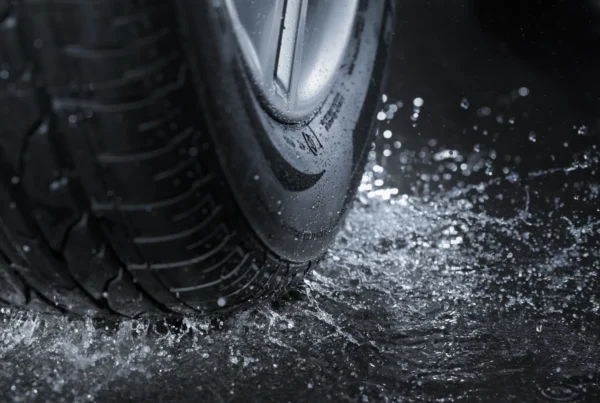
Wet grip and braking distance: where the tiers separate most
If you only look at one letter, look at the traction grade. It runs AA, A, B, C from highest to lowest and reflects measured stopping ability on wet government test surfaces of asphalt and concrete. The thresholds are real numbers: AA requires a locked-wheel friction coefficient above 0.54 on asphalt and 0.38 on concrete, A above 0.47 and 0.35, B above 0.38 and 0.26.
Now the catch, again straight from the required disclosure: that grade “is based on straight-ahead braking traction tests, and does not include acceleration, cornering, hydroplaning, or peak traction characteristics.”
Think about what that leaves out. A hard right onto Neil Street in a spring downpour is cornering. Standing water on Windsor Road after a storm is hydroplaning. Neither is in the letter, so two tires can both read A and behave very differently in the weather Champaign County hands you between March and June.
And here is the finding that outranks tier choice entirely. AAA, testing with the Automobile Club of Southern California’s Automotive Research Center, compared new all-season tires against the same tires worn to 4/32 inch. Braking from 60 mph on wet pavement, the worn tires needed 43 percent more distance on average, an extra 87 feet for a car and 86 feet for a light truck, with handling down 33 percent for the car and 28 percent for the truck.
That gap opened up on worn tread, not on a cheaper tier, and AAA saw the same degradation on every tire tested, including the higher-priced models.
So the honest order of operations is: replace on time first, then pick a tier. AAA suggests shopping at 4/32 inch, checked with an upside-down quarter: slide it into a groove, and if you see all of Washington’s head, start shopping. Illinois law is far more permissive. Under the state vehicle code a tire is not defective until tread drops below 2/32 inch, and it cannot be sold below 3/32. The legal floor and the safe replacement point are not the same number, and the gap is measured in stopping distance. One tire or a full set depends on your drivetrain and tread mismatch, covered in how many tires you actually need to replace at once.
Tread compound and construction: the part you cannot see
A tire is not a rubber donut. The U.S. Tire Manufacturers Association says as many as 200 raw materials go into one, and that is where tier differences live.
The tread compound. Rubber gets mixed with oils, carbon black, silica, antioxidants and other additives, each chosen, in USTMA’s words, to deliver specific performance characteristics. Carbon black and silica are both reinforcing fillers, and the balance between them is a real engineering lever: it shifts the trade-off between wear resistance, wet grip and how flexible the rubber stays in the cold. Upper-tier lines lean on silica-heavy compounds, sometimes layered so the outer and base rubber do different jobs. That is often why a higher tier grips better wet and cold without giving up wear.
The casing. Under the tread sit the body plies and belts, often polyester and steel, which USTMA describes as giving the tire strength to carry weight while keeping the flexibility needed for a comfortable ride. Extra or stiffer layers and heavier sidewall rubber change how it holds shape in a corner, shrugs off a pothole, and survives a sharp rock on gravel.
The bead. Bronze-coated steel wire hoops in the sidewall clamp the tire to the rim and keep the seal airtight, which is why it holds pressure through a winter of freeze-and-thaw swings.
You cannot see any of this on the showroom floor. It shows up at 40,000 miles, which is exactly why it is hard to shop for.
Road noise and ride: the axis nobody puts on the sticker
There is no federal letter grade for how loud a tire is, which is a shame, since noise is what people notice on day one and complain about for four years. Quieter tires come mostly from tread pattern design, varying the size and spacing of the blocks so the tire scatters frequencies instead of droning, plus more compliant construction that passes less road texture into the cabin. Both tend to improve as you move up a lineup, because both cost engineering effort.
With no number to compare, judge it the only way that works:
- Drive the car on the surfaces you actually live with, not just smooth blacktop.
- Listen at 65 to 70 mph on I-74 or I-57, where tread noise is loudest, then on a county road toward Savoy or St. Joseph.
- Ask what customers with similar vehicles report. A shop that has mounted these lines hundreds of times has better noise data than any spec sheet.
What realistically survives here: 124 freezing days, wet springs, and gravel
Champaign-Urbana is not a gentle test loop for any tier. Long-term normals at Champaign’s Willard Airport show about 123.5 days a year at or below 32 degrees, an average January high of 33.5 and low of 17.2, and 39.72 inches of precipitation a year. That means cold-weather flexing, standing water, and freeze-thaw churning the pavement into potholes by February.
Then add the local mix of surfaces. A commuter running US 45 down from Rantoul or I-74 in from Mahomet wears tires gently compared with someone in St. Joseph or Tolono finishing the trip on township oil-and-chip or gravel. Same tire, same tier, very different result: the gravel driver is fighting cuts and sidewall abrasion, not just tread wear.
The decisions that matter most are usually not about the tier at all:
- Rotation on schedule, so the front pair does not wear out at half the life of the rears.
- Inflation pressure checked monthly, especially in the cold months when it drops on its own.
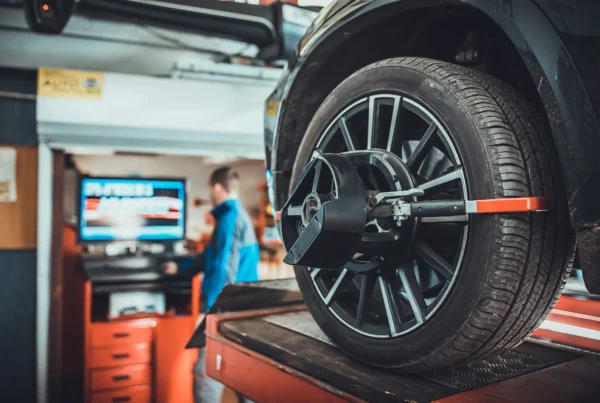
- Alignment, because a car slightly out of spec will shave down a mileage-warranty tire early and cheerfully.
Do those three and a mid-tier tire can outlast a neglected top-tier one. Skip them and no tier reaches its number.
Price is not the spec, and independent testing says so
AAA’s conclusion was blunt: tire performance does vary by brand, but price is not necessarily an indicator of quality.
Consumer Reports found the same on wear. It runs tires 16,000 miles on public roads in West Texas, projects tread life from the measured wear, and reports that the longest-lasting tires do not necessarily cost the most. Among 15 all-season SUV tires it tested, nearly half projected out to at least 65,000 miles and four past 75,000.
So the top of the wall is not automatically right, and the bottom is not automatically a mistake. The right tier is the one whose strengths match how you drive.
How to shop tiers at a tire shop near you in Champaign
Bring three things and you will run the conversation instead of following it:
- Your size, load index and speed rating, from the sticker in the driver’s door jamb rather than the tires on the car now, which may be wrong.
- How you drive. Interstate miles, city stop-and-go, gravel lanes, a work truck carrying weight, a student car parked outside all winter. Each points to a different tier.
- What matters most to you. Longest wear, best wet stopping, quietest ride. You cannot maximize all three, and naming your priority is what makes a recommendation useful.
Then ask these at the counter:
- Which tiers are even available in my exact size? Sometimes the answer is one or two, and the decision makes itself.
- What is the treadwear grade and traction letter on each option?
- What does this line’s mileage warranty require from me, and do you document rotations?
- What does installation include? See what mounted and balanced covers.
Then ask for a current quote on those options. Not a number from a blog post, including this one. Tire pricing moves with size and availability, so any figure written here would be stale by the time you read it. A quote on your size, today, is the only number that means anything, and you can ask us for one before you come in.
Norris Tire & Auto is the tire shop Champaign IL drivers use when they want the trade-offs explained instead of a tier pushed on them, and we do the same for neighbors in Urbana, Savoy, Mahomet, Rantoul, St. Joseph and Tolono. Bring us your door-jamb sticker and a sentence about how you drive, and we will lay out what genuinely changes between the options that fit your vehicle, then quote the current numbers on those sizes. Schedule an appointment and let’s find the right tire for the roads you actually drive.