
You back out of a parking spot on Neil Street, hear a rhythmic tick, and there it is: a nail head sitting flush in your tread. It is one of the most common reasons drivers in Champaign and Urbana call a shop, and the first question is almost always the same. Can a tire be patched, or is this a new tire?
The honest answer depends on where the nail went in, how big the hole is, and what the inside of the tire looks like once it comes off the wheel. Those are not opinions we make up shop by shop. The U.S. Tire Manufacturers Association (USTMA) and the Tire Industry Association (TIA) both publish repair rules, and a good shop follows them whether the answer makes the customer happy or not.
Here is how that flat tire repair decision gets made, in plain language, so you know what you are authorizing before you hand over the keys. It is the same walkthrough we give at the counter here in Champaign, whether the nail came from a construction detour off Prospect Avenue or a weekend drive out toward Mahomet.
First Things First: Do Not Pull the Nail Out
It feels like the natural thing to do. Don’t.
- Leave the object in place. A nail or screw still in the tread is often the only thing keeping a slow leak slow. Pull it and a tire that would have held air until morning goes flat in the parking lot.
- It also marks the spot. Finding a small puncture in a mounted tire takes a water bath and patience. The nail tells your technician where to look and what angle the object traveled at.
- Check your pressure, then decide. If the tire is holding close to the pressure on the sticker in your door jamb, a careful drive to the shop is usually reasonable. If it is soft or dropping while you watch, put on the spare or call for a tow.
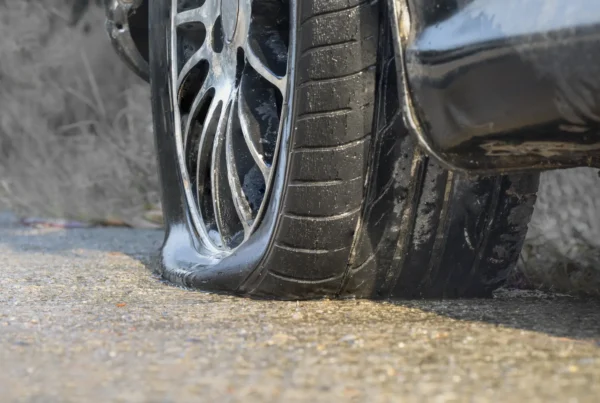
- Do not keep driving on a flat. Running a tire with little or no air destroys the casing from the inside. That is how a repairable puncture turns into a replacement.
If you keep an aerosol sealant or inflator in the trunk, know what it buys you. TIA says sealants and emergency inflators containing sealant are not recommended as long-term solutions to a flat tire. They are a way to reach a shop, nothing more.
Can a Tire Be Patched? The Repairable Area, Without the Jargon
Picture your tire in three zones. The crown, or center tread, is the part that meets the road. The shoulder is where the tread curves over toward the wheel. The sidewall is the smooth rubber wall between the shoulder and the rim.
Only the first zone is repairable.
USTMA limits repairs to the tread area. TIA words it even more tightly: puncture repairs are limited to the center of the tread area. Damage in the shoulder or the sidewall is not repairable, and USTMA adds that a repair is off the table when the injury extends into the shoulder or belt edge area, or when it angles from the tread into the shoulder. If there is any doubt about whether the injury reaches that zone, the tire comes out of service.
Size matters too. Both USTMA and TIA draw the line at one quarter of an inch, or 6 millimeters. Anything larger than that in diameter is not repairable, no matter how nicely it sits in the middle of the tread. A roofing nail is comfortably under the limit. A long gash is not.
Two examples show how much the location matters more than the object:
- A roofing nail picked up on a construction detour sits dead center in the tread, the tire held air overnight, and the hole measures well under a quarter inch. Textbook repair.
- A small screw is found near the outer edge of the tread, right where it wraps toward the sidewall. The screw is tiny, the tire looks fine, and the answer is still a new tire. Nothing in that zone can be repaired.
Drivers are usually surprised that the smaller object is the one that ends the tire. The rules are about the structure underneath, not the size of what made the hole. We have that conversation with customers from Savoy and Rantoul most weeks.
Tire Plug vs Patch: Why Neither One Alone Is a Real Repair
Here is where the tire plug vs patch question usually goes sideways. People argue over which one is better. The rules say you need both.
- A plug alone does not seal the innerliner. It fills the hole from the outside, but the airtight liner on the inside of the tire is still broken.
- A patch alone does not fill the void. It seals the liner, but the puncture channel through the rubber is still an open path.
TIA is direct about it: a plug by itself or a patch by itself is not an acceptable repair. The reason is water. Moisture that works its way into an unfilled puncture channel reaches the steel belts inside the tire and corrodes them. That damage is invisible from the outside and it does not get better with time.
The industry standard is a combination repair. USTMA describes it plainly: a rubber stem, or plug, must fill the puncture injury, and a patch must seal the innerliner. In the bay that is usually one combination unit, a patch with a stem attached, pulled through from the inside so it fills the hole and seals the liner in one piece.
That is the other half of the rule. USTMA says never perform an outside-in or on-the-wheel repair. Those roadside string plugs jammed in with a T-handle while the tire is still on the car are, in TIA’s framing, a temporary solution only. If someone once “fixed” a flat tire repair for you in five minutes without taking the wheel apart, that was a get-you-home measure, and the tire still needs a proper repair.
Flat Tire Repair Step by Step: What Happens When the Tire Comes Off the Wheel
TIA puts it simply: it is important that the technician remove the tire from the rim so that the inside can be thoroughly inspected. Here is what that actually involves.
- Demount. The tire comes off the wheel so both surfaces are visible.
- Inspect the inside. With good light, a technician looks at the innerliner for the puncture, for creasing, for loose rubber dust, and for any sign the tire has been run underinflated.
- Follow the injury path. The object rarely goes straight in. Probing the channel shows where it actually traveled, which is how an injury that looked like it was in the crown turns out to have angled into the shoulder.
- Check what else the inspection turns up. Old improper repairs, separations, and bead damage all show up at this stage, and any of them can change the answer.
- Prepare and repair. The area is buffed and cemented, the combination unit goes in from the inside, and the surface is sealed.
- Remount, balance, and set pressure. The tire goes back on, gets balanced, the tire pressure monitoring sensor is checked, and pressure is set to the vehicle’s specification. It is the same wheels-off attention your tires get during regular tire rotations.
That inspection is why a proper repair takes real time. Sticking the patch on is quick. Deciding whether the tire has earned one is the slow part.
The Damage That Cannot Be Repaired
Some tires get retired for reasons that have nothing to do with the nail that brought them in.
- Sidewall damage. Pirelli’s guidance is blunt: tread damage can sometimes be repaired, but sidewall damage means replacing the tire entirely, because it makes verifying what else is wrong inside impossible.
- A previous improper repair. USTMA says never repair a tire that already has an improper repair; it gets scrapped. If a string plug was pushed in from the outside years ago, that decision is already made.
- Overlapping or opposing injuries. Repairs cannot overlap. TIA adds that if two injuries are close enough that their repairs would overlap, or they sit directly across from each other, the tire cannot be repaired.
- Tread near the end of its life. TIA advises against repairing a tire worn to 2/32 of an inch. A repairable nail hole in a tire that is nearly finished is not worth the labor, and we will say so.
- A casing that has been run flat. Driving with little or no air can damage the internal structure regardless of how small the puncture is.
Nobody enjoys delivering that news. It is also why we inspect instead of guessing from the outside.
Run-Flat Tires Are Their Own Conversation
Plenty of newer sedans and crossovers around Champaign-Urbana came with run-flats. If yours did, the rules tighten up.
Run-flats are built to keep going briefly with no air. Pirelli’s guidance for its run-flat line is to drive home or to your preferred tire shop within 50 miles at a maximum of 50 mph, then change the tire. That is a way to get off the shoulder of I-74 or I-57 safely, not a reason to postpone the repair.
The catch is that the same stiff construction that lets a run-flat carry the car makes internal damage hard to confirm. A puncture in the crown can look tidy while the casing is already compromised, and no visual inspection rules that out with certainty. That is why a run-flat driven on with low or no pressure often has to be replaced even when a standard tire with the same nail would have been repaired.
One more rule worth knowing before you shop for tires: Pirelli notes that a run-flat should always be replaced with another run-flat, because substituting a standard tire compromises how the vehicle performs.
Why One Nail Can Mean Two Tires
When a tire cannot be saved, the next question is whether you are buying one or two. This is where customers often assume they are being upsold, so here is the reasoning.
Michelin’s guidance is that tires on the same axle must always be the same size, because size variations hurt balance, steering response, and braking. Michelin also recommends all four tires share the same size, type, speed rating, load capacity, and construction. When two tires are replaced, the pair with deeper tread goes on the rear axle to help maintain stability and wet traction.
All-wheel drive raises the stakes. Michelin notes that AWD systems typically require all four tires to have the same circumference, since even small differences stress drivetrain components over time, and that the vehicle manufacturer’s guidelines set the maximum allowable variation. Dropping one brand-new tire onto an AWD crossover with 30,000 miles on the other three creates exactly the mismatch those systems are sensitive to.
So the answer depends on your tires, not on a policy, and it is part of any tire and wheel service conversation we have at the counter. If your set is nearly new, one replacement usually matches fine. If your tread is well worn, we will measure what is left, check what your owner’s manual requires, and tell you whether a pair, or occasionally a full set, is the right call. Then you decide.
Tire Repair in Champaign IL: What It Costs and What to Do Next
We are not going to publish numbers here. Tire pricing, labor rates, and what is on the shelf change constantly, so anything written today would be out of date by the time you read it. For what your situation involves, ask us for a current quote. That is the fastest way to get an accurate answer for your vehicle and tire size.
A few things worth remembering:
- A nail in the center tread, under a quarter inch, is usually repairable. A nail in the shoulder or sidewall is not.
- A real repair happens with the tire off the wheel, with both a plug filling the hole and a patch sealing the liner.
- Plugs, string kits, and sealant cans are get-you-home tools, not the end of the story.
- Bring it in sooner rather than later. Most of what turns a repairable tire into a replacement happens in the miles driven on low air.
If you have been searching for tire repair near you, Norris Tire and Auto has served Champaign, Urbana, Savoy, Mahomet, Rantoul, and the surrounding Champaign County area since 1984. Bring the car in with the nail still in it and we will pull the wheel, inspect the tire the way the rules require, and give you a straight answer.
Schedule an appointment and we will take a look.