
The doorbell camera catches it around four in the afternoon: four black rings on the porch, wrapped in plastic, a shipping label on each. You found the size, compared reviews for a week, and clicked buy. Congratulations: you now own four tires and have exactly as many on your car as you did yesterday.
That is not a dig at buying online. Plenty of our Champaign-Urbana customers do it, and we install customer-supplied tires every week. But buying tires and installing tires are two separate transactions, and the second one is where the confusion lives. People book expecting a fifteen-minute swap, then see a line item for a valve service kit or a note about a road force balance and reasonably wonder what all of that is.
So here is the honest version of what tire installation in Champaign IL involves, from the lift going up to you driving away on the tires that were sitting on your porch.
The boxes are on the porch. Here is what still has to happen.
Every one of these is real work:
- The wheels come off the vehicle.
- The old tires get dismounted, and the wheels get inspected and cleaned where the tire seals against them.
- The new tires get mounted, seated, and inflated to the pressure your vehicle asks for.
- Each wheel and tire assembly gets balanced.
- The tire pressure monitoring hardware gets serviced, and sometimes relearned to the vehicle.
- The old tires get taken in for disposal.
- The wheels go back on and get torqued to the vehicle’s specification.
- You come back a short while later so we can re-check that torque.
That whole list is what “mount and balance tires” is shorthand for. What any of it costs depends on your vehicle, your wheels, and what your TPMS hardware needs, so we quote it live rather than guessing here. Call us or ask for a quote with your year, make, model, and wheel size, and you will get a real number for your car instead of one that was true for somebody else’s.
Mounting: what actually happens to your wheels
The tire machine gets the attention, but the useful work happens around it.
Once the old tire is off, the wheel gets looked at properly. The bead seat, the flat ring where the tire’s edge presses and seals, collects corrosion, old sealant, and a central Illinois winter’s worth of road salt. Put that surface back into service dirty or pitted and the new tire has a hard time sealing against it, which is how you end up with a slow leak nobody can find six weeks later. Cleaning it takes a few minutes. Chasing that leak later takes far longer.
Then the tire is lubricated, mounted, and inflated until the beads pop into place on both sides. That popping noise is the tire seating. After that it comes down to the pressure your vehicle calls for, which is on the sticker in the driver’s door jamb.
The number molded into the sidewall is not your inflation pressure. It is the maximum the tire is rated for, not what your car wants. The door jamb sticker is the number that matters, and it is the same sticker that gives you your correct size, load index, and speed rating. Our post on reading the sticker in your door jamb walks through every line on it, and it is worth reading before you order rather than after.
Balancing, and why “road force” is its own phrase
A standard spin balance solves a weight problem. The assembly spins on the balancer, the machine works out where it is heavy, and a technician adds a small counterweight opposite that spot. Done well, that is genuinely all most vehicles ever need.
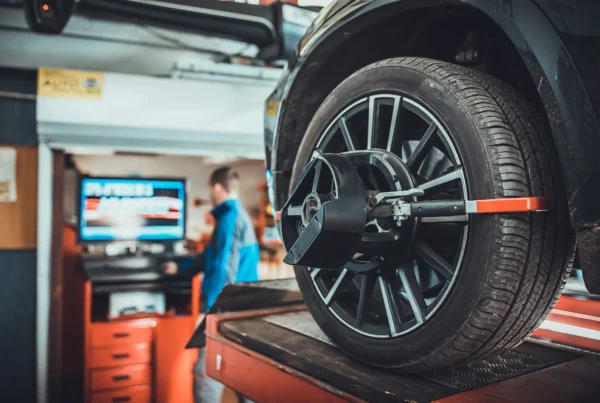
Road force measurement asks a different question. According to Hunter Engineering, whose balancers are what most shops mean by “road force,” the machine presses a load roller against the spinning assembly to simulate the load of the road. That reveals what a free-spinning balance cannot: variation in the tire’s own stiffness and roundness, runout in the wheel, a bead that did not seat evenly, lateral forces that make a car pull. It also lets a technician match-mount, turning the tire on the wheel so the tire’s high spot lines up with the wheel’s low spot and the two cancel out.
That explains a frustration a lot of drivers have had. If a brand-new set still buzzes through the steering wheel at highway speed on I-57 or I-74, the weights are usually not the problem, and no amount of added weight fixes force variation. Hunter also points out that miscentering the wheel on the balancer is the biggest single cause of a bad balance and a return visit, so how carefully the assembly goes onto the machine matters as much as the machine.
Ask about road force when a vibration survived a normal balance, when you run large-diameter or low-profile tires, or when you want the fussiest possible result on a new set. For a standard set on a commuter car, a careful conventional balance is not a lesser job. It is the right job.
TPMS sensor service in Champaign: the part most online orders forget
Federal safety standard 138 covers passenger cars, multipurpose passenger vehicles, trucks, and buses rated at 10,000 pounds gross vehicle weight or less, excluding vehicles with dual wheels on an axle. Unless you drive something old or unusual, your car has a tire pressure monitoring system. The standard is specific about the warning, too: the low pressure light has to come on when a tire drops to 25 percent below your vehicle’s recommended cold inflation pressure, and within 20 minutes of that happening.
That system lives inside your wheel, and a tire change is the one time anybody touches it. TPMS sensor service is not an upsell tacked onto a tire installation. It is the maintenance window.
Every sensor sits in the wheel behind a set of wearable parts: a sealing grommet, a valve core, a hex nut, and a cap. Together they are a service kit. Bartec USA, one of the major TPMS tool makers, says the kit should be replaced every time a tire is serviced, quoting vehicle manufacturers: always remove and replace used snap-in valves when replacing tires. That grommet has spent years squeezed between the stem and the wheel, cooked and frozen through however many Illinois summers, and it has taken the shape of the hole it sat in. Reuse it and you get a seep, which is a TPMS light a week later that everybody blames on the shop.
Sensors themselves are a separate matter. Their batteries are sealed in, so when one dies the sensor is replaced as a unit and the vehicle usually needs a relearn to know which sensor sits at which corner. We find that with the wheels off, and we tell you before we do it.
One more thing, plainly. Federal law makes it unlawful for a repair shop to knowingly make inoperative a device installed to meet a safety standard, and the National Highway Traffic Safety Administration has applied that directly to TPMS. Pulling a working sensor and handing the car back with the system dead is not a corner we are allowed to cut. A sensor that was already dead on arrival is a different situation, and you hear about that too, rather than finding out on your next drive.
Your old tires still have to go somewhere
Illinois takes used tires seriously, with reason. The Illinois EPA puts the state’s output at more than 14 million used tires a year, more than one per resident. The Used Tire Management Act of 1992 created the fund that pays to clean up the piles, supported by a per-tire user fee collected on tires sold at retail.
The practical consequence for you: Illinois law requires tire retailers to accept a used tire for every new tire purchased, and the Illinois EPA tells consumers to report retailers who refuse. A website in another state is not standing in your driveway to take the old four away. A local tire shop is. Disposal is a handling step with a cost attached, which is why it shows up on the invoice.
Torque to spec, and the retorque nobody schedules
The last thirty seconds of the job is the part that keeps the wheel attached to your car.
Lug nuts have a torque specification set by your vehicle’s manufacturer, and it is a specification, not a suggestion. NAPA’s guidance is the industry-standard version: use a torque wrench rather than a spider wrench, breaker bar, or impact gun, tighten in a star pattern, go around twice, and stop when the wrench clicks instead of pushing past it. The number comes from your owner’s manual and varies a lot by vehicle, so nobody should be doing it by feel.
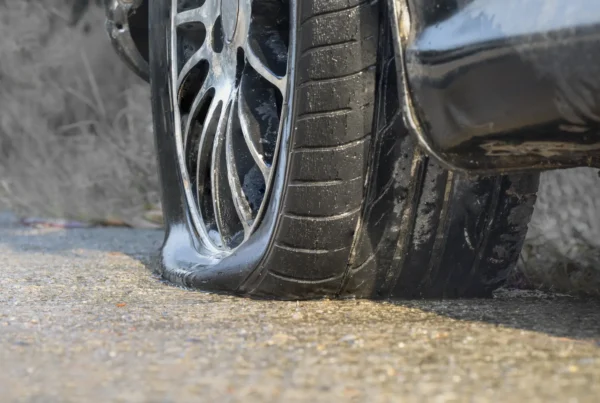
Too loose is obvious trouble. Too tight is quieter trouble: stretched studs and rotors distorted by uneven clamping force, which turns up later as a pulsing brake pedal that gets blamed on the brakes.
Then there is the step almost nobody plans for. Continental’s guidance is that a wheel settles into place after installation, and that normal driving stresses can leave lug nuts slightly tighter or looser than they were when they left the shop, so wheels should be re-checked and brought back to specification a short distance after a tire change. Loose lug nuts mean a wobble at best and a wheel coming off at worst. A retorque takes minutes. We would rather you made the trip back in from Urbana, Savoy, Mahomet, Rantoul, or St. Joseph than skip it. Put it in your phone before you leave the lot.
Which protections survive an online purchase, and which do not
The manufacturer’s warranty travels with the tire. Michelin’s standard limited warranty, to take one widely published example, covers defects in workmanship and materials for the life of the original usable tread or six years from purchase, whichever comes first. That coverage follows the tire rather than the installer, but Michelin conditions it on buying from an authorized dealer and registering the tires, so check that the site you ordered from is one.
Road hazard coverage does not travel automatically. Michelin’s standard warranty expressly excludes road hazard damage, and that is typical. Road hazard protection is a separate product, usually sold by whoever sold you the tire, at the time you bought it. Buy online without adding it at checkout and you generally cannot add it later, and any claim goes back through that seller.
Workmanship on the installation is ours. A wheel weight that comes off, a valve stem that seeps, a balance that was not right: that is our work, and we stand behind it.
That distinction matters most in February, when a freeze-thaw pothole on a Champaign side street takes out a sidewall. Not a manufacturing defect, so the tire warranty will not touch it, and whether anything else covers it comes down to what you bought at checkout. Whether the damage can be repaired at all depends on where it sits on the tire, which our post on when a tire can be repaired and when it has to be replaced covers in detail. Keep your invoice somewhere findable, because every one of these claims starts with it.
What to check before you click buy, and what to ask when you book
Before you order:
- Size, load index, and speed rating off the door jamb sticker, not off whatever the site guessed for your vehicle.
- The DOT date code on the tires when they arrive, so you know how long they sat in a warehouse first.
- Whether your wheels need anything special for TPMS, particularly if they are aftermarket.
- Whether your installer takes customer-supplied tires at all. Not every shop does. We do.
When you book, ask us:
- What the installation includes for your vehicle, and what it comes to. That is a live quote, not a blog post number.
- Whether your TPMS needs service kits, sensors, or a relearn.
- Whether a road force balance is worth it for your setup, and an honest answer when it is not.
- When to come back for the retorque.
Once the new set is on, the cheapest way to protect it is to rotate it on schedule, which we cover in our post on tire rotations.
Norris Tire & Auto has been doing this in Champaign since 1984, back when tires came from exactly one place and it was a building with a lift in it. Times changed, that is fine, and we would rather install your online tires properly than watch you drive on a set somebody rushed. If you want a tire shop in Champaign IL that will mount and balance tires bought somewhere else without making it weird, that is us.
Schedule an appointment and bring the boxes.